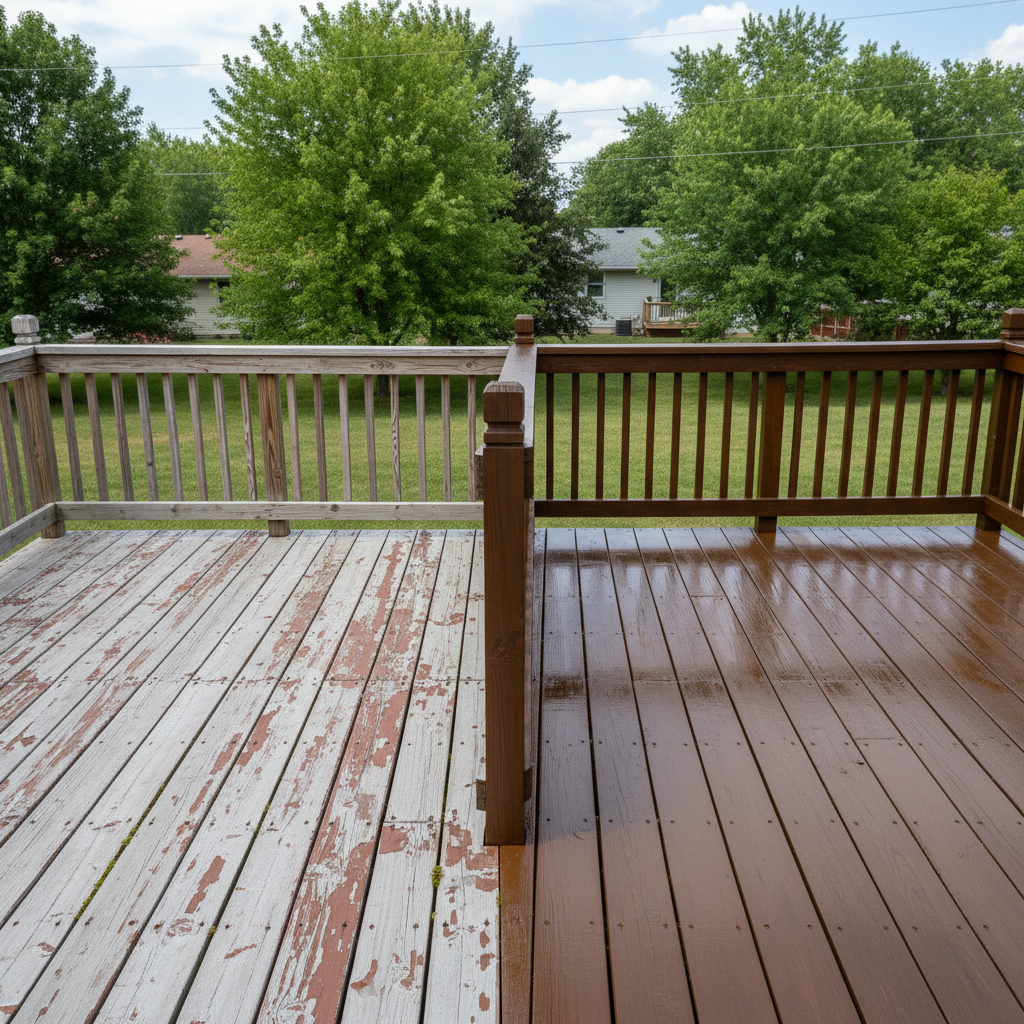
Should you paint or stain your wooden deck? If you live around Zanesville, that question usually pops up right about the time the spring humidity hits and you are trying to get the backyard ready for grilling season. You look out at weathered boards, maybe some fading from last year's sun over the Muskingum River valley, and you want to know what choice is actually going to hold up.
All Star Deck Solutions looks at how these two options really stack up when they face local conditions.
The Core Difference: How They Sit on the Wood
Paint forms a thick, protective skin right on top of the lumber. It completely hides the grain and lets you pick almost any color under the sun. Stain, on the other hand, sinks deep into the wood pores. It absorbs rather than coats, meaning you still see the natural character and texture of the boards.
That mechanical difference dictates everything else about how Deck Construction and wood preservation perform.
Durability Through Ohio's Weather Swings
Our local weather is brutal on outdoor wood. We get blistering summer heat, heavy spring downpours, and freezing winter cycles that make lumber expand and contract continuously.
- Paint: Because paint forms a rigid film on top, it does not flex well when the wood moves. After a couple of heavy freeze-thaw cycles, painted horizontal boards tend to crack, bubble, and peel in sheets, especially near high-traffic zones like back doors or stairs.
- Stain: Penetrating stains move right along with the wood fibers. They do not peel off in flakes. Instead, they gradually fade over time, which makes future touch-ups and re-coats much simpler without requiring heavy scraping or stripping.
Cost and Initial Investment
Upfront expenses usually come down to prep work and product quality. Painting often requires a solid primer coat followed by two layers of heavy-bodied acrylic paint. If your deck is older or has seen better days, painting can mask imperfections and ugly patches. Staining is typically more straightforward to apply initially, though semi-transparent and solid stains have different price points depending on solids content.
All Star Deck Solutions always tells homeowners to look at the long-term cost of ownership, not just the weekend material bill. A painted deck that starts peeling after two winters means you are spending your Saturdays scraping and repainting far sooner than you want to.
Maintenance Realities
High-traffic areas on Zanesville decks take a beating from foot traffic, lawn mower debris, and patio furniture. When a stained deck starts looking dry or worn in a high-traffic path, you can usually clean it, apply a maintenance coat, and blend it right in. When a painted deck fails, you are often looking at a patch job that stands out until you redo the whole platform.
Our Local Recommendation
If you have a sound, pressure-treated wood deck that gets full exposure to the elements, go with a high-quality semi-transparent or solid penetrating oil or hybrid stain. It allows trapped moisture to escape the wood rather than sealing it inside to rot from within. Save paint for vertical surfaces like railings or porch columns where moisture does not pool as easily. Keep up with your routine cleaning, and All Star Deck Solutions ensures your Deck Construction project will stay solid for many years in the Zanesville climate.